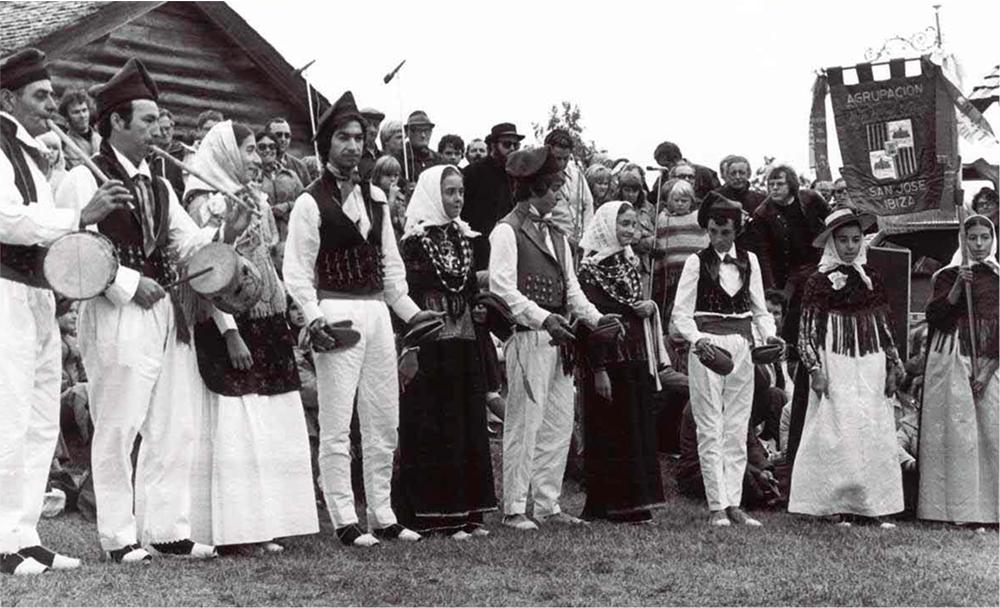
Sonades and Gaites:
The Music of Tradition
The traditional music of Ibiza and Formentera is inseparable from the traditional Ibizan dance. Instruments such as the ‘flaüta’ (flute), drum, and castanets have resonated for generations, accompanying ceremonies, festivities, and rituals of daily life in the Pityusic Islands. Always performed live, these ‘sonades’ (tunes) possess a unique and deeply rooted character.
Recently, the federation has recorded a series of ‘sonades’ and ‘gaites’ to make them available to everyone and to create an up-to-date record, as faithful to tradition as possible, of the music that comprises the traditional Ibizan dance.


TYPES OF SONADES
Sa Curta
This is the ‘sonada’ that generally initiates the dance. The rhythm is relatively slow and the intensity
quite gentle, appropriate for starting the celebration in a relaxed manner. The music of this dance has a
ternary rhythm. Currently, in ‘sa curta’, only the person performing the dance plays the castanets.
The ‘sa curta’ ‘sonada’ can also be known as ‘sa plana’.
Sa Llarga
This ‘sonada’ is very different from ‘sa curta’. To begin with, its rhythm, unlike ‘sa curta’, is quaternary.
The intensity with which the instruments perform this ‘sonada’ is higher. It is a ‘sonada’ where the dancer’s movements are more vigorous and accentuated. Furthermore, the overall rhythm of all participating instruments is faster.
Regarding the ‘flaüta’ ‘sonada’, it should be noted that both the melody of ‘sa llarga’ and that of ‘sa plana’ or ‘sa curta’ are composed of small, improvised fragments joined together.
Mass Sonades
As previously mentioned, another important group of ‘sonades’ are those included within the Mass, or that may be directly related to it. In this context, the best-known Mass ‘sonades’ may include “Sa caramellera”, “Els gotxos”, “Es credo”, “Kyries”, “S’alçar Déu”, “El pas de Maria”, or “Entrada de missa” and “Sortida de missa”.
Gaites (Composer's Tunes)
Within this group, there is a wide variety of ‘sonades’, some more modern and others older,
such as “Sa calera” or “Es jugaroi”.
With these melodies, the musicians often devised
their own ‘sonades’. A significant portion of these ‘sonades’ can be dated to the period between the late 19th and early 20th centuries. These musicians had already traveled outside the island, and their compositions received influences from various places.
Historical Context
The combination of ‘flaüta’ (flute), drum, and castanets is unique to Ibiza and Formentera. It is believed that this practice originates from ancient times, with influences that could date back to Eastern and Mediterranean cultures. Unlike other traditional music, Ibizan ‘sonades’ are never played with sheet music; they are transmitted orally and learned by heart.
Would you like to delve deeper?
A complete educational sheet with technical and contextual information about the instruments and the ‘sonades’.
Traditional Instruments
Drum
This is the dance modality that formerly initiated and concluded the dances. As its name indicates, it is a short-duration dance; the steps and rhythm are very slow and calm, appropriate for starting the celebration in a relaxed manner, and which will gradually increase in intensity with the other dances. The music of this dance has a ternary rhythm.
Castanets
They are generally made of juniper wood. Each castanet is composed of two halves called ‘tapes’ and a ‘badall’. The castanets can be embroidered with geometric figures and plant motifs, and occasionally also painted. Current Ibizan castanets are also among the largest in Spain.
Flaüta
The ‘flaüta’ is the only wind instrument that can accompany the dances. It is just over two ‘palms’ long and is made of ‘baladre’ (mock privet). This ‘baladre’ is hollowed out with red-hot punches.
Espasí
Originally, it was a sword blade from which the handle or hilt had been removed, hence its shape and name. It is a metallic instrument with a sound very similar to that of a triangle found in orchestras. Its use was restricted to accompanying the ‘caramelles’ on Christmas Eve, but now it can be seen accompanying dances.
SONADES AND GAITES: COMPILATION
Version 2025
Musicians:
Name Surname 1 — Colla de Sant Rafel
Name Surname 2 — Colla de l’Horta
Name Surname 3 — Colla de l’Horta
WANT TO HEAR IT LIVE?
Consult the dance directory
Experience the traditional Ibizan dance live — consult the calendar of ‘pou’ dances and popular dances.