

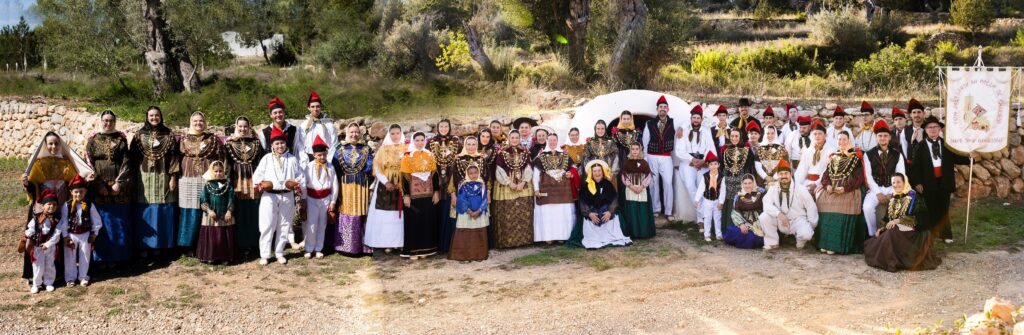
Sa Colla de Labritja is a non-profit organization founded in 1984 by students from Labritja Public School, with the aim of promoting the folklore, music, and typical dances of the island of Ibiza, carrying out cultural exchanges, and organizing healthy recreational activities for youth.
What was initially a simple extracurricular activity has expanded over the years and today is a Cultural Association composed of more than 40 members of all ages, residents of the villages of Sant Joan de Labritja, Sant Vicent de sa Cala, and Sant Llorenç de Balàfia, who dedicate a significant part of their leisure time to activities related to the aforementioned group.
The Cultural Association Sa Colla de Labritja dedicates special attention to learning its dances, having compiled various typical dances from the North of the island, thanks to contact with the oldest residents of the area.
In its educational aspect, the Sa Colla de Labritja Association dedicates two days a week to conducting dance and music classes. Dance classes are taught separately for men and women, followed by a joint rehearsal, and music classes are exclusively for men, who must acquire knowledge, at a minimum, of “castanets”, also receiving classes in “drum” and “flute”. These classes are taught at Ceip Labritja.
Furthermore, attire is very important, which is why SA COLLA DE LABRITJA also dedicates part of its attention to the research and compilation of information regarding the authenticity of its costumes, being permanently in contact with elderly people who can still recall what the clothes they wore “when they were young” were like, as they say.
Therefore, the work carried out by various members of the group can be highlighted, by attending courses where they are taught the technique for making certain garments, what materials are appropriate, etc., notably the workshop for making typical Ibizan espadrilles and that of shawls and different costume pieces, for both men and women, which SA COLLA DE LABRITJA , together with the Sant Joan de Labritja Town Council, has been organizing in recent years, and due to their great acceptance, they continue to be held every year.
Furthermore, SA COLLA DE LABRITJA is also concerned with compiling ancient traditions and customs related to folklore. An example of this is the revival of the old “ballades” (dances) at the wells of the Municipality of Sant Joan, specifically the Pou de Labritja, in Sant Joan (whose performance takes place on the Sunday before Santa Maria de les Neus), the Pou des Baladre in Sant Vicent de sa Cala (whose ballada takes place in April, coinciding with the patron saint festivities according to the program established each year), and the Font de Balafia in Sant Llorenç (whose ballada takes place on the last Sunday of August). These ballades are celebrated in places where, according to the elderly, no one had danced for over 50 years.
Furthermore, Sa Colla de Labritja performs various shows throughout the year, including: at the patron saint festivities of Sant Vicent de sa Cala, Sant Joan, and Sant Llorenç; festivities of Portinatx, Festes de la Mare de Deu in Sa Cala, December 26th in Sant Joan de Labritja, Tourist Day in Portinatx and at the Port of Sa Cala,…
Additionally, Sa Colla de Labritja also constantly works to carry out cultural exchanges with other folkloric groups from outside the island. Among the most notable participations, we can mention:
- Participations of various members of Sa Colla in various International Folkloric Festivals held in Palma de Mallorca, achieving different awards in all categories.
- Participations of some members of Sa Colla, chosen by other groups on the Island to perform outside the Island.
- As well as cultural exchanges held with groups, among others, from: Extremadura, Murcia, Inca – Mallorca; Lugo – Galicia; Manacor – Palma de Mallorca; Andorra, Alqueries del Niño Perdido – Castelló; Martorelles – Barcelona; Lanzarote – Canary Islands; Pont Saint Maxence – Paris; Atzeneta del Maestrat – Castelló; Tenerife – Canary Islands; Menasalbas – Toledo; Culleredo – A Coruña; Vielha, Legazpi – Guipuzkoa; Taradell – Barcelona; Betera – Valencia; Cocentaina – Alicante; Calzada de Calatrava – Ciudad Real; Barakaldo – Bizkaia; Azambuja – Portugal; Felanitx – Mallorca; Lloret de Vistalegre – Mallorca; Balingen – Germany; Sanlúcar la Mayor – Seville; Tembleque – Toledo; Guia de Isora – Tenerife; Burgos, Murcia, Cangas do Morrazo – Pontevedra; Gran Canaria.
Some of these exchanges have been repeated several times.
- Without exchange: Montserrat – Barcelona, Manchester, Gràcia – Barcelona, Balingen – Stuttgart.
SA COLLA DE LABRITJA is, above all, an entity open to the outside. Thus, the permanent contact it maintains with the other folkloric groups on the island can be mentioned, supporting each other and carrying out mutual exchanges of “ballades”.
Furthermore, we must mention that Sa Colla de Labritja is constituted as a Cultural Association and has its own statutes, with meetings held regularly.
Finally, it should be noted that this Association is part of the “Federation of Dance and Popular Culture Groups of Ibiza”, promoting through this Federation the study of the typical dances and music of the island.


